Vision-X
Qualcomm Snapdragon Multiverse — National Finalist, Top 10
Radar that finds a heartbeat through a wall — built so a fire crew can carry it into a burning building.
WHAT IT DOES
- Cleared Round 1 and Round 2 of the Qualcomm Snapdragon Multiverse Hackathon (Noida, 2026), advancing to the National Finals and placing in the Top 10 teams
- Led a 4-person team architecting a 4-tier edge-to-cloud AI system to detect living victims through walls, across rooms, and through smoke for firefighters and disaster-response teams (NDRF-targeted)
- Designed an IR-UWB radar + CNN pipeline (clutter removal, range-FFT, micro-Doppler analysis) to confirm vital signs from breathing motion (~0.2-0.5 Hz), distinguishing living victims from static heat sources
- Architected a graceful-degradation multi-device system spanning Arduino UNO Q, mobile, Snapdragon Copilot+ PC, and Qualcomm Cloud AI 100, keeping every tier operational if higher tiers lose connectivity
- Designed on-device LLM-based hands-free voice guidance (Snapdragon NPU) for responders and a sensor-fusion pipeline for real-time multi-unit building mapping and downed-firefighter detection
- Authored the full technical design document and feasibility study, grounding the architecture in peer-reviewed RF-sensing research (MIT CSAIL RF-Pose, WiTrack)
Python
Language
2
Stars
0
Forks
Sept 2026
Last push
FROM THE REPOSITORY
README
Vision-X
Finding living people through walls, across rooms, and smoke — and giving rescue teams a hands-free sense in zero visibility.




Multi-device AI · AI PC · Mobile · Arduino UNO Q · Qualcomm Cloud AI 100
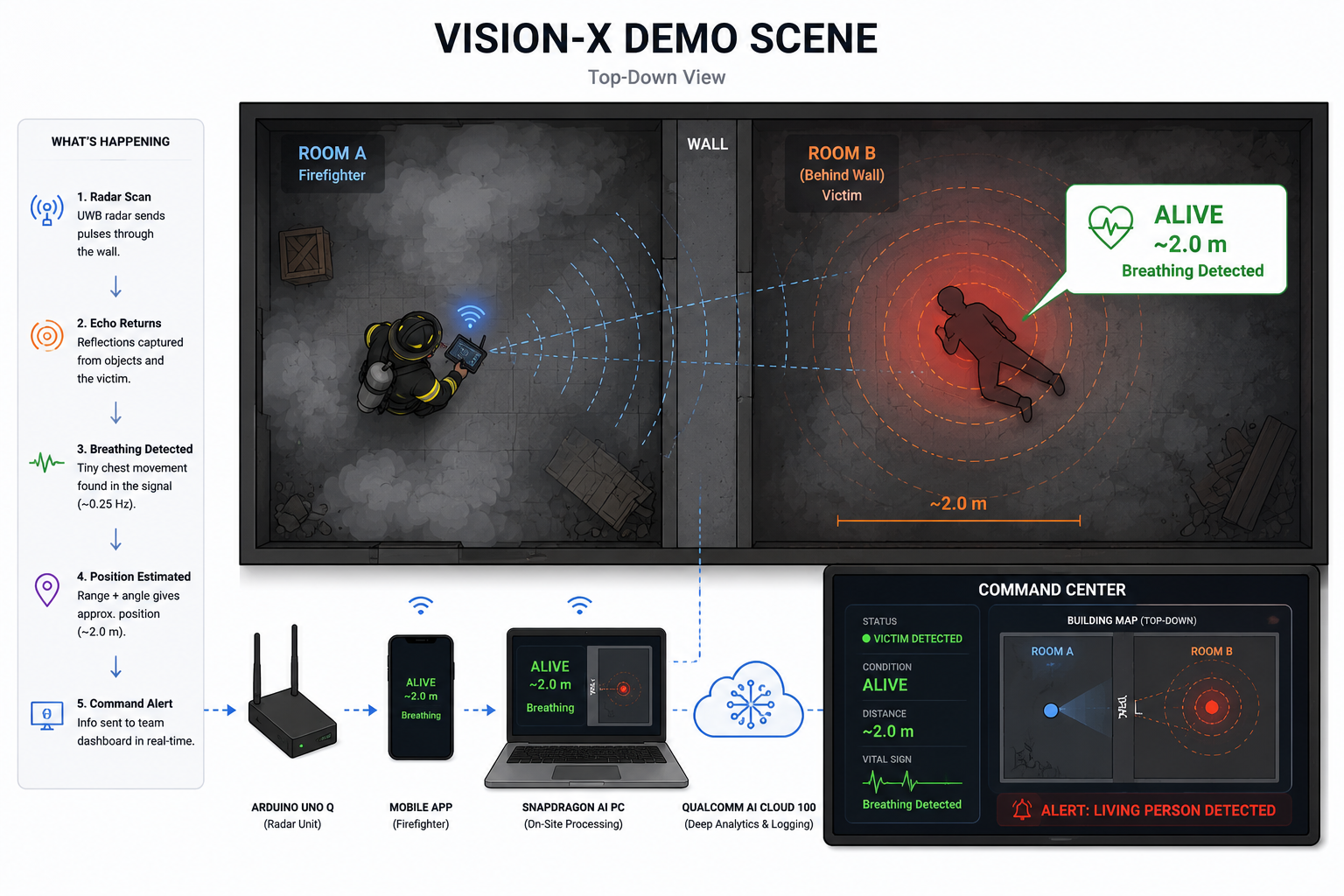
Vision-X in action (top-down view). A firefighter in Room A detects a person collapsed in Room B through the dividing wall: UWB pulses pass through, the system estimates range (~2 m) and detects presence, the phone speaks the cue, and the Command Center flags "PERSON DETECTED." The device chain (Arduino UNO Q → phone → Snapdragon PC → Cloud AI 100) runs along the bottom.
The question that decides everything inside a fire: Is there a living person behind this wall — in the next room — where exactly, and is there still time — answered before the firefighter commits to entering.
Vision-X is a four-device AI system that helps firefighters and rescue teams locate living people through walls, across rooms, and smoke — and confirm they are alive — using impulse ultra-wideband (IR-UWB) radar, distributed intelligence, and hands-free spoken guidance. It does not replace the thermal camera; it adds the see-through-walls, is-it-alive sense the camera lacks.
Full design document — view it live (GitHub Pages) (print-friendly HTML, with all figures) · markdown version · raw HTML source
Contents
- The 30-second version
- The problem
- The solution — one principle
- System architecture
- The four devices
- How it works
- AI / ML pipeline & toolchain
- Tech stack
- Repository structure
- Demonstration plan
- Datasets
- Feasibility & challenges
- Novelty & prior art
- Roadmap
- Getting started
- Team
- References
- License
The 30-second version
| What | A see-through-walls, across-rooms "is-it-alive" sense for firefighters, distributed across four Snapdragon-class devices. |
| How | IR-UWB radar passes through walls and doors into the next room — and through smoke; on-device AI confirms a living person from the millimetre motion of breathing. |
| Why multi-device | One capability is split so each device does only what that device can — and every tier keeps working if the one above it loses connectivity. |
| The demo | A hidden person in the next room → the firefighter, on the other side of a solid wall, pauses and detects "living person, ~2 m, behind this wall, breathing" before entering — and it still works with the room full of smoke. |
| Why it's low-risk | Every ingredient (through-wall UWB vitals, RF localization, on-device AI) is independently proven. The integration is the contribution. |
The problem
Inside a burning building, a firefighter's best perception tool is the thermal imaging camera — but it has two blind spots that kill:
- It is line-of-sight. It cannot see through a closed door, a wall, or a floor.
- It reads heat, not life. A hot appliance or a just-vacated spot looks like a person; a person behind a barrier looks like nothing.
So the decisive question — is there a living person behind this wall, in the next room? — goes unanswered at the exact moment it matters most. (Optical cameras and LiDAR don't even get that far: smoke defeats them entirely.)
Radio frequency answers what heat and light cannot. UWB penetrates interior walls, doors, and floors — so a firefighter can sense a living person in the next room before entering — it passes straight through smoke, and radar can detect the millimetre chest motion of breathing. The same RF that finds trapped civilians also finds a downed colleague — and loss of situational awareness inside structures is tied to a large share of the dozens of firefighter line-of-duty deaths each year.
Most Indian state Fire and Emergency Services operate without thermal imaging at all, so the perception gap here is even wider. Vision-X targets India's state fire services and the National Disaster Response Force (NDRF), running on commodity IR-UWB radar and Snapdragon edge hardware at a fraction of a thermal camera's cost.
The solution — one principle
Push every decision to the lowest device that can make it, and ensure each tier keeps working if the one above it disappears.
That single design rule produces the entire architecture and its strongest argument.
- Data shrinks as it climbs the stack — a raw radar echo becomes a detection, then a position, then a building-wide picture — while intelligence grows.
- The result is graceful degradation:
- the node finds a victim with no network,
- the phone guides one firefighter with no command post,
- the PC coordinates a building with no internet,
- the cloud links sites only when a backhaul exists.
Disaster zones force exactly this property — and it happens to be the precise distributed edge-to-cloud AI story this hardware is built for. Every device is non-substitutable because of where the intelligence has to live, not because it was added for effect.
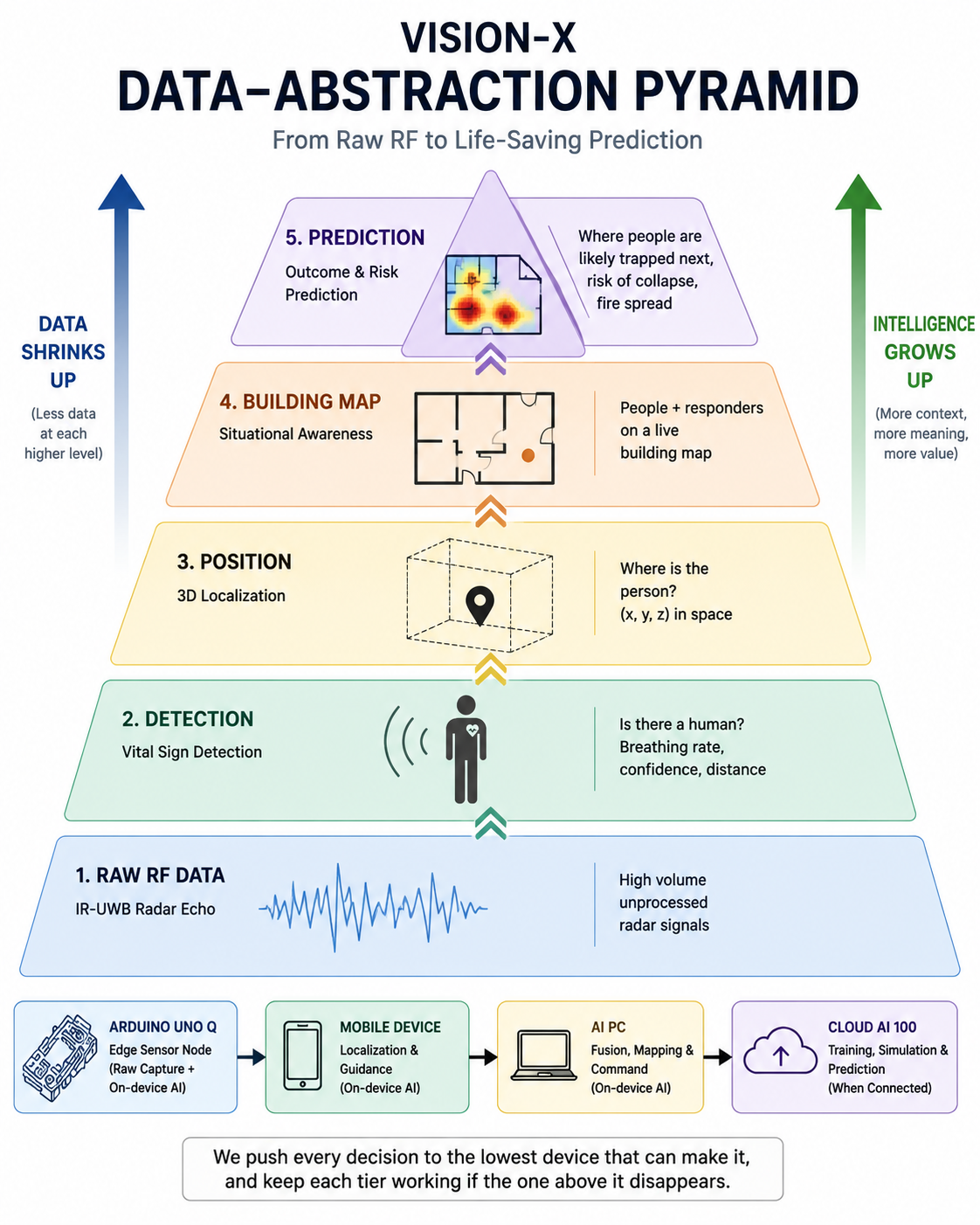
The core principle, visualized. Bottom to top: raw RF echo → vital-sign detection → 3D position → live building map → trapped-occupant prediction. Data shrinks as it climbs (less, more abstract) while intelligence grows — each level handled by the lowest device that can do it: UNO Q → phone → AI PC → Cloud AI 100.
System architecture
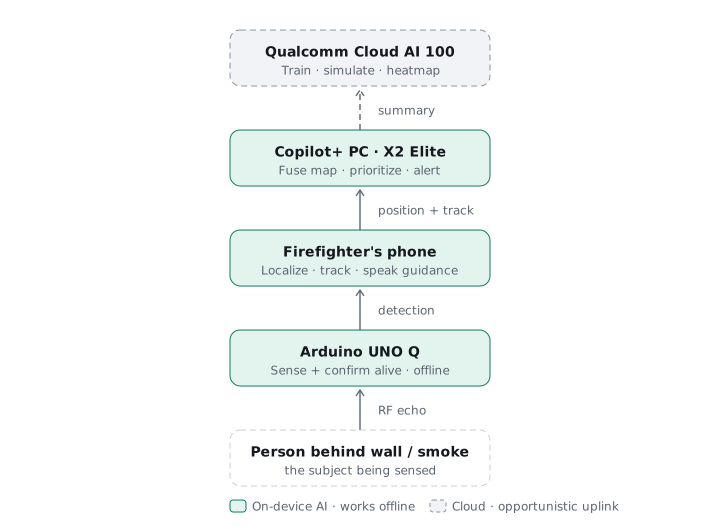
Four tiers, from the physical world up to the cloud. Each arrow carries a more abstract product than the one below it; two refined products flow back down.
Read the diagram: solid arrows are always-available local links; dashed arrows are opportunistic. Each tier runs even if the tier above it is unreachable. Every figure also lives in
docs/images/and the full design document.
Graceful degradation — the multi-device payoff
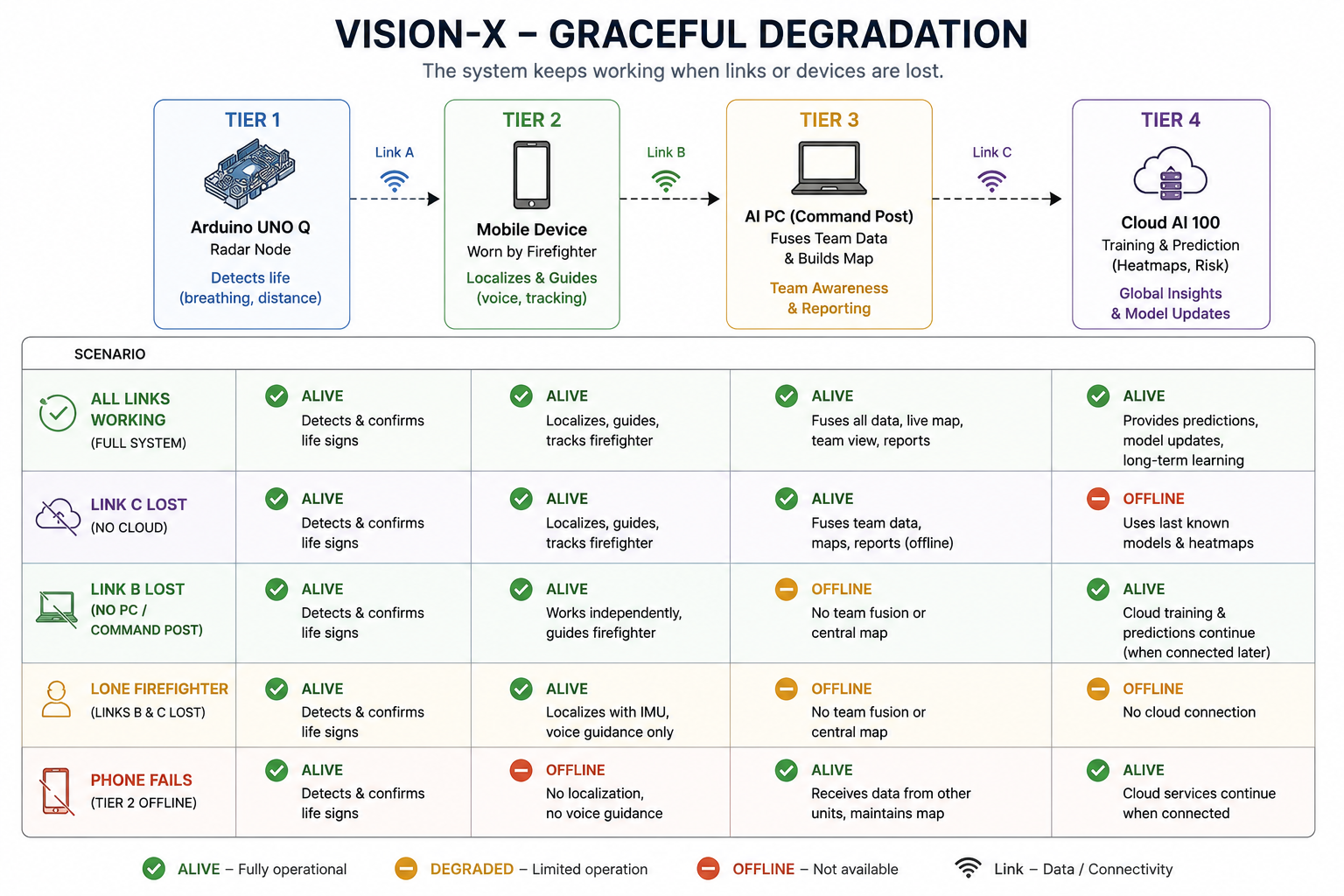
What survives when links or devices are lost. Cloud lost → PC, phone, node still run (uses last heatmap); command post lost → each phone still guides its own firefighter; lone firefighter → still gets victim detection + voice guidance; a phone fails → its node still raises a standalone alert and the PC keeps the other units. Green = fully operational, amber = degraded, red = offline.
The four devices
| Tier | Device | Job — and why nothing else can do it |
|---|---|---|
| Edge node | Arduino UNO Q (Dragonwing QRB2210 + STM32U585) | Carries the IR-UWB radar. The STM32 captures radar frames on a hard real-time clock; the Dragonwing MPU runs on-device AI (clutter removal + lightweight ML classifier) and emits a compact detection. Raw RF never leaves the board. An autonomous detector that works in a burning structure with no network. |
| Mobile | Firefighter's phone (worn on SCBA/chest) | Fuses radar sweeps with its own IMU to localize the victim, tracks the firefighter's own path by dead reckoning, and runs a small on-device LLM that speaks guidance into the comms (a gloved, masked firefighter can't read a screen). Also shows every teammate's live position. |
| AI PC | Copilot+ PC (X2 Elite) (Hexagon NPU) | The incident-command brain at the scene — private, internet-free. Fuses every responder and every detection into one live building map, pushes the team picture back to every phone, raises the downed-firefighter alarm, and writes the commander's situation report. Many-to-one fusion is what a single moving phone structurally cannot do. |
| Cloud | Qualcomm Cloud AI 100 | The heavy, building-scale work: trains/improves the edge models (OTA), and from a building blueprint runs structural-collapse + fire-spread simulation to predict a heatmap of where people are likely trapped. Non-blocking — with no uplink the system uses the last precomputed heatmap and loses nothing critical. |
Full role write-ups: node/ · mobile/ · pc/ · cloud/
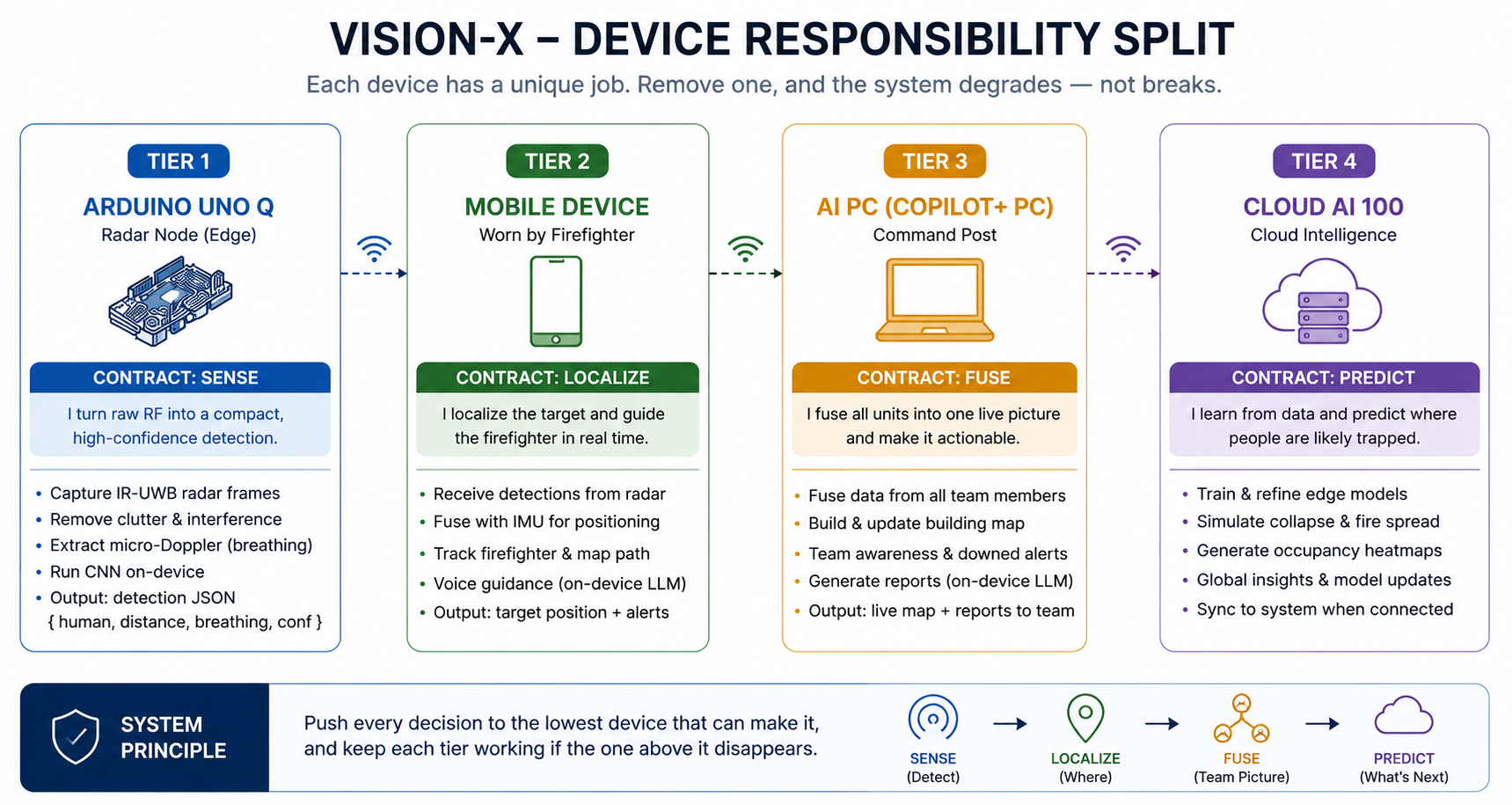
One job per device — remove one and the system degrades, not breaks. UNO Q = SENSE (raw RF → compact detection), phone = LOCALIZE (position + voice guidance), AI PC = FUSE (one live team picture), Cloud AI 100 = PREDICT (learn + forecast where people are trapped). Each box lists that device's exact inputs and outputs.
How it works
1. Seeing through walls, into the next room
The radar emits ultra-wideband pulses and reads the reflections. Radio at these frequencies passes through common non-metallic walls, doors, and floors — and through smoke — and the human body reflects it, so a firefighter can sense who is in the next room without entering. Echo delay gives distance (range bins); a person is found by the motion in those bins.
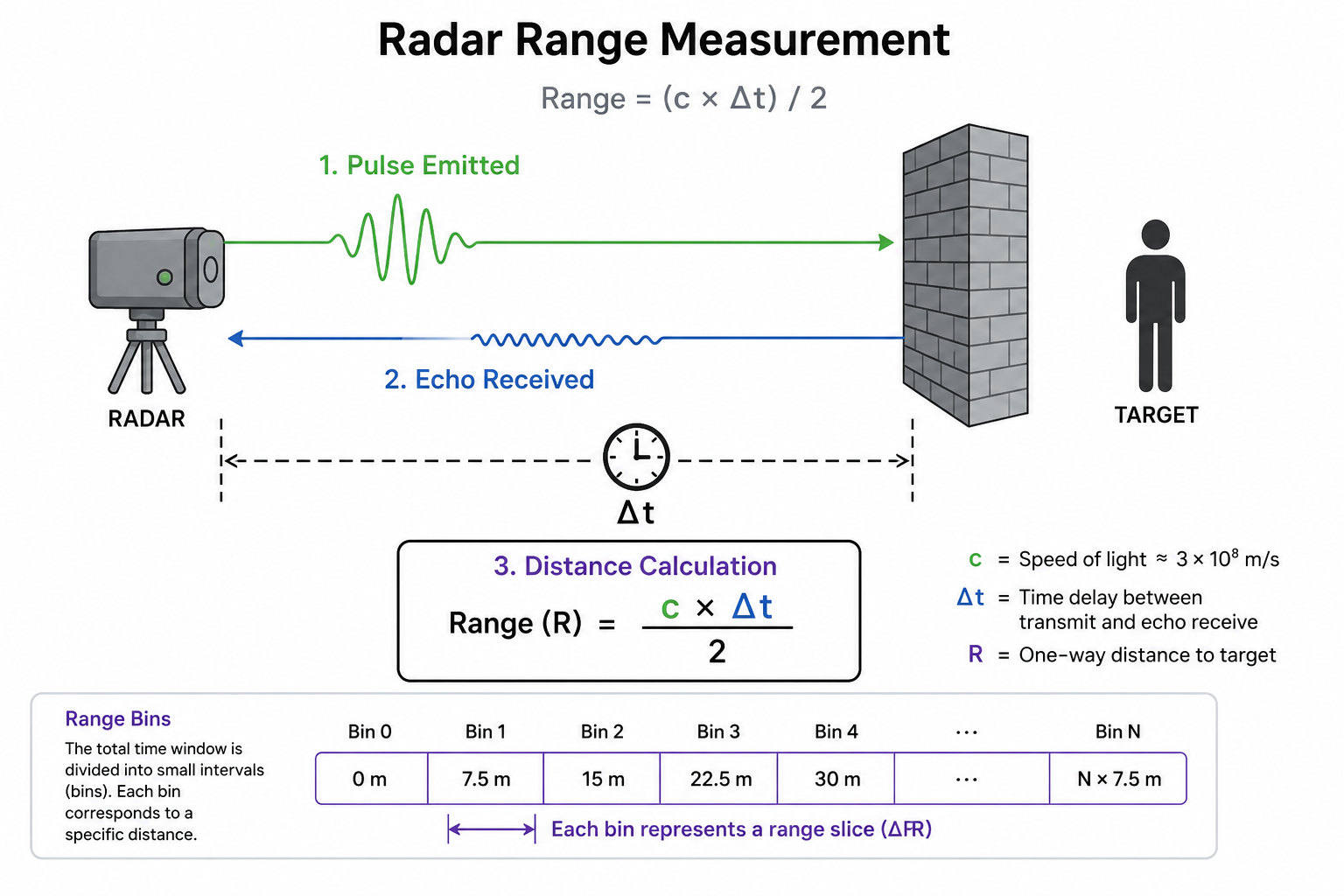
How distance is measured. A UWB pulse passes through the wall to the target and the echo returns; the round-trip time Δt gives range via R = c·Δt/2. The time window is sliced into range bins, each a fixed distance — the person is the bin whose echo moves over time.
2. Detecting a person (presence + range)
The radar emits ultra-wideband pulses and reads the reflections through walls, doors, and floors. Humans reflect RF energy differently than static clutter, so Vision-X identifies a likely person return by combining clutter removal with range-domain motion/returns across sweeps. Echo delay gives distance (range bins), turning “a return is present” into range estimates for the next-room cue.
3. The motion problem → detect robustly
On a moving firefighter, the sensor’s own motion can be larger than the person-related signatures. Vision-X handles this with detect-robustly rather than vitals-confirmation:
- While advancing, motion detection helps filter dynamic clutter and isolates candidate person returns (“contact, that way”).
- The firefighter sweeps and stabilizes briefly at the wall to improve the signal-to-noise ratio for detection and range estimation.
More advanced IMU motion compensation and motion-trained models that perform reliably during continuous movement are roadmap items.
4. Localizing the victim
One reading gives range, not a position. As the firefighter sweeps from slightly different spots, the phone fuses successive ranges with its IMU to triangulate: "person behind this wall, ~2 m, low to the floor."
5. Tracking the firefighter across the blueprint
Indoors GPS fails, so position comes from IMU pedestrian dead reckoning (gyro heading + accelerometer footstep detection, integrated from the entry door = map origin; barometer for floor). Drift is anchored by zero-velocity updates at each footfall, map-matching to corridors/doors, and optional UWB anchors at the entry. This yields a live "where is everyone" view, greys out swept rooms, and gives — for free — a downed firefighter's last-known location.
Honest accuracy: a few metres of absolute position over a mission (enough to place a contact in the right room); the relative victim cue is sub-metre.
6. Data-flow recap
raw RF echo (node, real-time)
  → confirmed detection (node MPU, offline)
    → relative position + firefighter track (phone, offline)
      → fused building map + situation report (PC NPU, local)
        → occupancy prediction + multi-site picture (cloud, opportunistic)
Two flows run back down: the cloud's occupancy heatmap → the PC, and the PC's fused team positions → every phone. Awareness that needs the whole picture is computed once, centrally, and distributed.
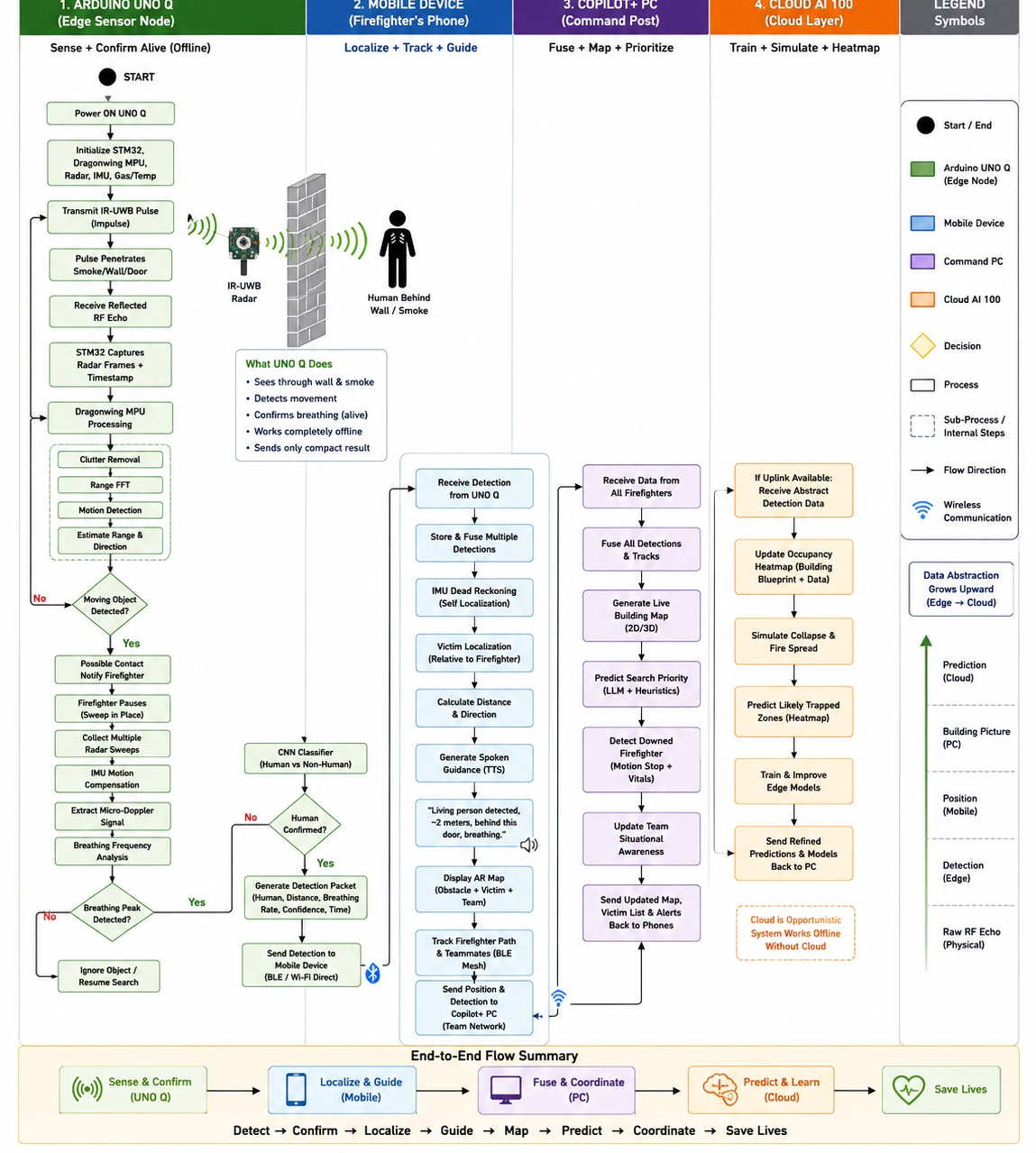
End-to-end process flow. Four swimlanes — UNO Q (sense + confirm alive, offline), mobile (localize + track + speak), Copilot+ PC (fuse + map + prioritize), Cloud AI 100 (train + simulate + heatmap) — traced from the radar pulse all the way to "Save Lives," with data abstraction growing upward (Edge → Cloud).
7. From collapse to search priority — the cloud's contribution
When a backhaul exists, the cloud turns the building blueprint and live detections into a search plan: it reconstructs the collapsed structure from radar + IMU data, builds a 3D occupancy heatmap of where people are most likely present, and ranks rooms by search priority so teams hit the highest-probability zones first. It stays non-blocking — if the uplink drops, the last computed heatmap is used.
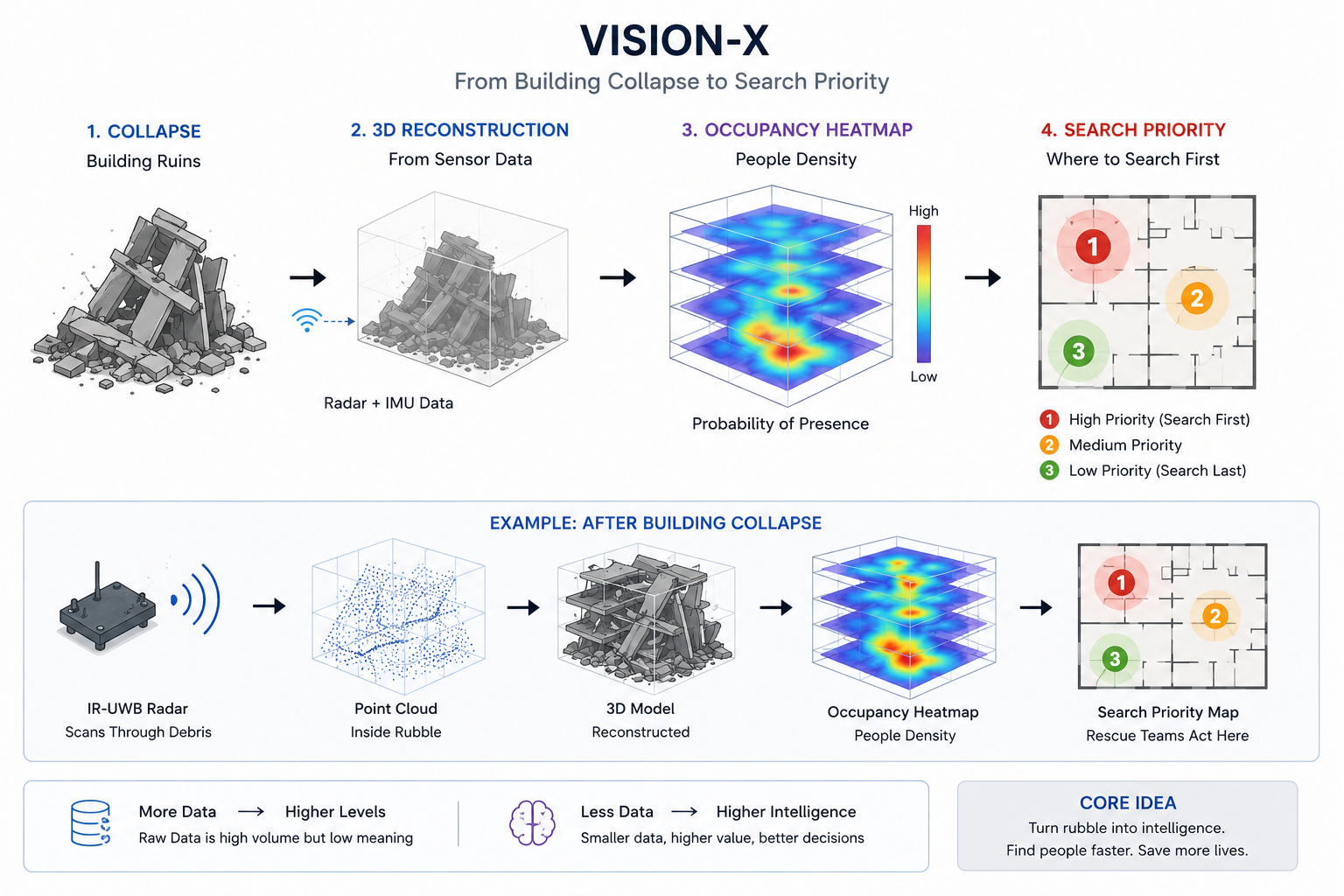
The cloud's job — turn rubble into a search plan. Collapse → 3D reconstruction (from radar + IMU) → occupancy heatmap (probability of people, layer by layer) → search-priority map (red = search first, green = last). The same data-shrinks / intelligence-grows principle, applied to disaster response.
AI / ML pipeline & toolchain
| Where | What runs | Stack |
|---|---|---|
| Node | clutter removal → range-FFT → micro-Doppler / breathing analysis → small ML classifier | Edge Impulse (UNO Q's native TinyML path) or TensorFlow Lite on the Dragonwing MPU; STM32 does real-time capture |
| Phone | small on-device LLM (e.g. Llama 3.2 3B) for offline spoken guidance, speech in/out | Qualcomm AI Hub → QNN / Genie on the NPU (ONNX is the NPU path on Snapdragon, not GGUF) |
| PC | sensor-fusion + occupancy prediction, larger on-device LLM with retrieval grounded in the floor plan | AnythingLLM on the Hexagon NPU (~45 TOPS), all private / offline-capable |
| Cloud | heavier occupancy-likelihood model; (future) retraining the edge detector from aggregated data | Qualcomm Cloud AI 100 |
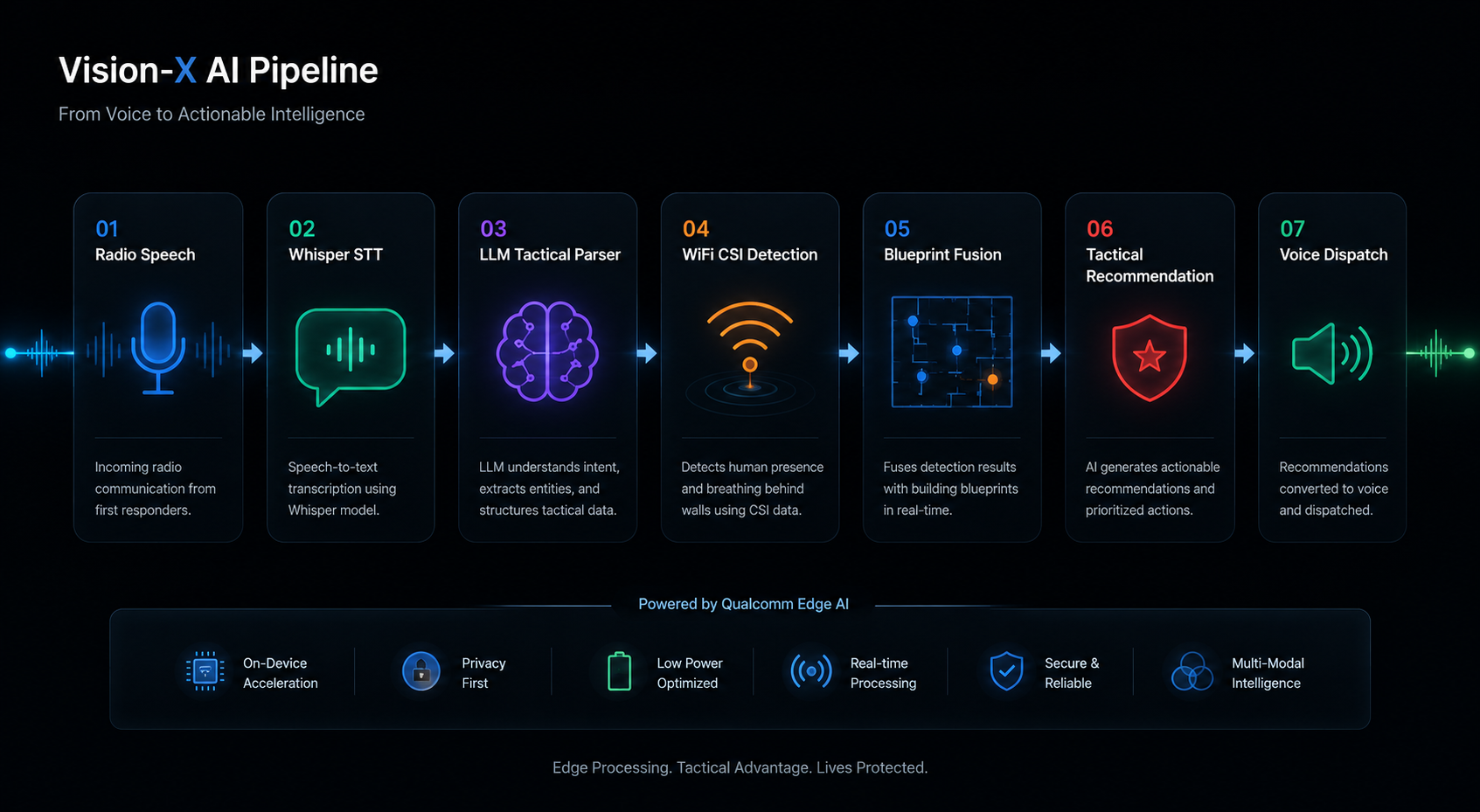
On-device AI pipeline (runs on the UNO Q). Raw IR-UWB echo → clutter removal (drop static walls/objects) → range-FFT (time delay → distance) → micro-Doppler extraction (breathing / subtle-motion signatures) → lightweight ML model (human vs non-human + vitals) → compact detection JSON (
human, distance, breathing_rate, confidence, status).
Toolchain: Qualcomm AI Hub + qai_hub_models (supports Snapdragon X Elite and X2 Elite), QNN / QAIRT, the Genie LLM runtime, ONNX Runtime, Edge Impulse, TensorFlow Lite, and Arduino App Lab.
Tech stack
Hardware — Arduino UNO Q (Qualcomm Dragonwing QRB2210 + STM32U585) · a team-supplied IR-UWB radar module (BYOD) · 6/9-axis IMU · CO + temperature sensor · Snapdragon Copilot+ PC (X2 Elite) · mobile device · Qualcomm Cloud AI 100.
Software / AI — Qualcomm AI Hub · QNN / QAIRT · Genie · ONNX Runtime · Edge Impulse · TensorFlow Lite · Arduino App Lab · AnythingLLM.
Connectivity — BLE / Wi-Fi Direct (node ↔ phone) · scene Wi-Fi / mesh (units ↔ PC, two-way) · opportunistic cellular / satellite (PC ↔ cloud).
Repository structure
Vision-X-Through-Wall/
├── README.md                      ← you are here
├── LICENSE
│
├── docs/                          ← design documents & figures
│   ├── DESIGN.md                    full design document (markdown)
│   ├── ARCHITECTURE.md              deep architecture & data-flow dive
│   ├── DEMO.md                      demonstration runbook
│   ├── DATASETS.md                  public datasets + how we use them
│   ├── DEPLOYMENT_GUIDE.md          exporting & running models on-device
│   ├── RESULTS.md                   benchmark results
│   ├── ROADMAP.md                   milestones & future scope
│   ├── PROPOSAL.md                  condensed 500-word overview
│   ├── PLANNING.md                  Fireground Command AI build spec
│   ├── BUILD_BRIEF_PHASE0-1.md      command-post laptop track, phases 0–1
│   ├── images/                      all diagrams & figures (SVG + PNG)
│   └── Vision-X_design_document.html   print-friendly design doc
│
├── firmware/                      ← sensing hardware (see firmware/README.md)
│   ├── esp32/                       ESP32 WiFi-CSI firmware (main.cc, sdkconfig)
│   └── unoq-radar/                  Arduino UNO Q app — STM32 sketch/ + Linux python/
│
├── fallback/                      ← laptop-mode CSI radar (ESP on USB → WebSocket → dashboard)
│   └── 01_csi_presence/             ruview_presence.py, dashboard, run scripts
│
├── training/                      ← optional ML kits (the live radar is pure DSP, no ML)
│   ├── tinyml/                      HB100 doppler: collect / train / infer apps
│   └── csi/                         CSI feature-MLP: collect / train / infer
│
├── mobile/                        ← firefighter phone — hands-free mobile brain
│   ├── app/                         React Native / Expo field app (+ Whisper-NPU module)
│   └── MOBILE_BRAIN.md              on-device compute & guidance design
│
├── visionx-laptop/                ← command post, phase 1: MQTT ingest → fusion → dashboard
│   ├── backend/                     FastAPI + aiomqtt + WebSocket fan-out
│   └── frontend/                    built React dashboard (served statically)
│
├── fireground-command-ai/         ← offline incident-command decision-support co-pilot
│   ├── schemas/                     Pydantic v2 data contracts (source of truth)
│   ├── backend/                     agent roster, event bus, incident state, I/O backends
│   └── dashboard/                   React + Vite command dashboard
│
├── src/visionx/                   ← the Python package: data, training, evaluation, export
├── tests/                         ← pytest suite for the package
├── configs/                       ← layered YAML experiment configs
├── examples/                      ← standalone snippets (edge_infer.py)
├── hall-map/                      ← standalone floor-plan viewer (single HTML page)
│
├── node/  ·  pc/  ·  cloud/       ← per-tier architecture notes (see "The four devices")
└── assets/                        ← logos, banners, media
Where to start: firmware/README.md for the hardware
(wiring, gotchas, and the exact data each sensor publishes),
fallback/01_csi_presence/RUN_FALLBACK.md
to bring the radar up on a laptop, and docs/DESIGN.md for the full system design.
Note on hardware config: WiFi credentials and transmitter MACs in the firmware and CSI tooling are placeholders (
YOUR_WIFI_SSID,AA:BB:CC:DD:EE:FF). Set your own before flashing — viafirmware/esp32/sdkconfig, and--tx-mac/CSI_TX_MACfor the pipeline.
Demonstration plan
The demo build delivers one vertical slice: a single UNO Q with one IR-UWB module detecting presence, distance, and breathing through a solid wall; the phone showing the live cue; the PC showing a fused map with one LLM situation line. The cloud runs as a thin sync stub or a second site on a slide.
The demo moment: a person hidden in the next room, behind a solid wall. The "firefighter" — in the adjoining room, visor obscured — pauses at the wall, and before entering gets the hands-free cue "living person detected, ~2 m, behind this wall, breathing," while the command-post screen lights up the contact on its map. Fill the room with smoke and nothing changes — RF doesn't care.
The detect-then-confirm flow (walk up, pause, sweep) is the real intended workflow, and genuinely sensing a living person through a solid wall — no line of sight, no trick — makes the demo authentic rather than simulated. Full runbook → docs/DEMO.md.
The illustration at the top of this README shows this exact moment, end to end.
Datasets
The detector is pretrained on public IR-UWB data and fine-tuned on the actual wall on-site. Two halves are covered: detect-through-the-barrier and confirm-alive.
- Through-wall detection — a dataset built specifically for victim detection behind walls/obstacles with a UWB radar sensor.
- Vitals under motion —
nesl/MobiVital(IR-UWB chest signals + synchronized IMU + ground-truth respiration) andRadarDataforCSBHRD(breathing + heart rate during activity). These are close-range, line-of-sight, cooperative — pair them with the through-wall set. - Optional gesture control —
UWB-gestures(9,600 labelled samples). - Index —
awesome-radar-perception, a curated hub of radar datasets and detection / domain-adaptation papers.
Details and licensing → docs/DATASETS.md.
Feasibility & challenges
| Challenge | How Vision-X addresses it |
|---|---|
| Respiration from a moving worn sensor | The demo confirms breathing during a stationary dwell — a clean FFT spectral peak, a proven stationary-sensor technique. Confirming breathing while moving (IMU motion compensation + a motion-trained ML model) is roadmap, not the demo build. |
| Justifying the cloud | scoped to opportunistic occupancy-likelihood prediction and made non-blocking, so it reinforces graceful degradation instead of undermining the offline thesis. |
| The phone as more than a screen | it runs localization, firefighter tracking, and the guidance SLM on its NPU; the display is the output of real compute. |
| Firefighter self-localization | IMU dead reckoning anchored by zero-velocity updates, map-matching, and optional UWB fixes; absolute accuracy claimed at a few metres, the relative cue at sub-metre. |
| Downed firefighter | rides on the same sensors: motion-stop + vitals for detection, last-known trail point for location, UWB homing to reach them through smoke. |
Novelty & prior art
The physics is proven (through-wall UWB vital-sign detection), the AI is proven (RF-based pose and localization), and individual pieces of the firefighter stack already exist — SmokeNav (mmWave + IMU navigation), C-THRU (a thermal see-through-smoke HUD), and POINTER (responder tracking). But none of them fuse, as one distributed multi-device system on Snapdragon silicon:
- commodity RF that confirms a living victim through walls and across rooms (and through smoke),
- the detection AI running on the sensor node itself,
- a hands-free responder unit that localizes the victim, and
- a command-level coordination + occupancy-prediction layer.
That integration is the contribution — and it is low-risk precisely because every ingredient is independently validated.
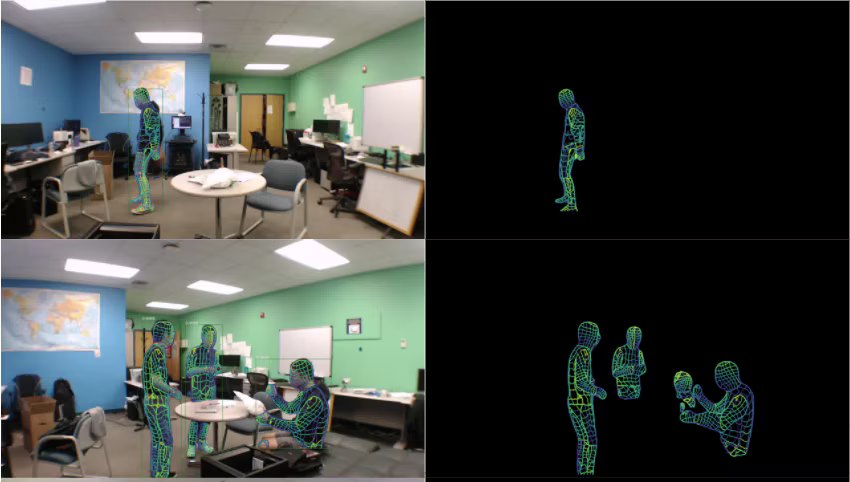
Prior art that de-risks us — and our future direction. RF-Pose research (Zhao et al., MIT CSAIL) reconstructs full 3D human meshes from radio reflections alone, proving RF carries rich pose information. Vision-X ships with presence + breathing first; 3D posture (slumped vs. moving) is the roadmap extension. Illustration of the published research direction — not a Vision-X output.
Roadmap
- Breathing confirmation under motion — IMU motion compensation and a motion-trained ML model, removing the need for a still dwell.
- Federated, privacy-preserving training across fire services — shared models improve without centralizing sensitive incident data.
- 3D pose & skeletons (the RF-Pose direction) — tell a slumped victim from a moving one.
- Multi-victim simultaneous tracking and antenna-array imaging for richer through-wall scenes.
- Heart-rate during stationary dwells as signal processing matures.
- Integration with building systems — fire-safety panels, pre-plans, dispatch / CAD.
- Productization — heat-hardened enclosure, ruggedization, and field certification; target unit cost well below a thermal imaging camera, procured through state fire services and the NDRF.
- Adjacent applications — earthquake search-and-rescue, privacy-preserving elder-care fall detection, secure presence sensing.
Full milestone plan → docs/ROADMAP.md.
Getting started
Run the radar on a laptop — the quickest path to something live. An ESP32 on USB, no UNO Q needed:
cd fallback/01_csi_presence
pip install -r requirements.txt
./run_ruview.sh /dev/ttyUSB0 <YOUR_ROUTER_MAC>     # Windows: run_ruview.bat COM3 <YOUR_ROUTER_MAC>
Then open dashboard/index.html. Full walkthrough: RUN_FALLBACK.md.
Everything else:
| What | Where |
|---|---|
| Hardware wiring, gotchas, sensor data contract | firmware/README.md |
| Flash the ESP32 CSI firmware | firmware/esp32/ |
| Build & deploy the UNO Q app | firmware/unoq-radar/REPRODUCE.md |
| Field app (Android APK) | mobile/app/ · mobile/README.md |
| Command-post dashboard (phase 1) | visionx-laptop/README.md |
| Incident-command AI | fireground-command-ai/README.md |
Train the ML models (visionx package) |
docs/DEPLOYMENT_GUIDE.md |
| Optional on-device TinyML kits | training/ |
Per-tier architecture notes: node/ · mobile/ · pc/ · cloud/
Team
Team HoneyBadger.
| Role | Member |
|---|---|
| Team Lead · AI/LLM & software | Omkar (@HoneyBadger-010) |
| Signal processing, radar & embedded firmware | Ashutosh Chaudhari (@Ashutosh-Chaudhari) |
| DevOps / cloud | Atul |
| Software · mobile & PC | Vedant |
References
Selected prior art grounding the feasibility and novelty claims — full list in docs/DESIGN.md.
- Zhao et al., "Through-Wall Human Pose Estimation Using Radio Signals" (RF-Pose), CVPR 2018, MIT CSAIL.
- Adib et al., "WiTrack: 3D Tracking via Body Radio Reflections," USENIX NSDI 2014.
- Adib & Katabi, "See Through Walls with WiFi," ACM SIGCOMM 2013.
- "Ultra-Wideband Impulse Radar Through-Wall Detection of Vital Signs," Scientific Reports 2018.
- Chen et al., "SmokeNav," Advanced Intelligent Systems 2024.
- Qwake / DHS S&T C-THRU; NASA JPL / DHS S&T POINTER.
License
Released under the MIT License.
Vision-X — accuracy figures are honest engineering estimates; production deployment requires ruggedization and certification.
Vision-X · multi-device edge-to-cloud AI for search & rescue